
A new year offers a useful moment to review how we observe, analyse and design. Originally written for the beginning of the Persian year 1401 in 2022, this article considers habits that can continue beyond that occasion. Architectural thinking grows through sustained attention, not a sudden change of tools or a collection of fashionable images.

Observe before proposing a solution
Look closely at ordinary places: the entrance people avoid, the seat they choose, the path worn across a courtyard. Record light, weather, movement and use as well as form. Nature can suggest patterns and relationships, but copying a natural shape does not automatically produce an effective building.
Separate observation from interpretation. First describe what happens, then suggest why. A shaded edge may be popular because of temperature, privacy or a view; the same visible behaviour can have several explanations. This distinction makes the design question more precise.
Read beyond reference images
Architecture books help establish context, while literature and accounts of everyday life can sharpen attention to people and place. Reading should generate questions: whose activities are represented, what assumptions shape the brief, and how does a space support or limit those activities?
Choose a small number of useful references and analyse their plans, sections and details. Identify the problem each project addressed before borrowing an element. A striking facade is not a complete explanation of the building behind it.
Learn tools through an architectural task
Tools such as 3ds Max, Revit or Rhino can support modelling, coordination and visualisation. Learn them through a defined exercise rather than treating software proficiency as a substitute for architectural judgement. A convincing image still needs appropriate dimensions, construction logic and a workable plan.
Set a focused task: model a stair junction, compare two window proportions or develop a small room layout. Explain the decision in drawings and words, then ask whether the tool made the relationship clearer. The objective is better reasoning as well as better output.
Study built work and discuss it critically
Review local architecture and Farid + Arjmand projects with attention to their programme and setting. Vernacular examples can reveal responses to climate and daily routines, but they should be studied in context rather than treated as solutions that transfer unchanged to every site.
Architectural competitions can provide a structured exercise in reading a brief and presenting a response. Compare the programme, limits and evaluation criteria before developing a proposal. Participation alone does not guarantee creative growth; reflection on the decisions and feedback is what makes the exercise useful.
A small weekly practice
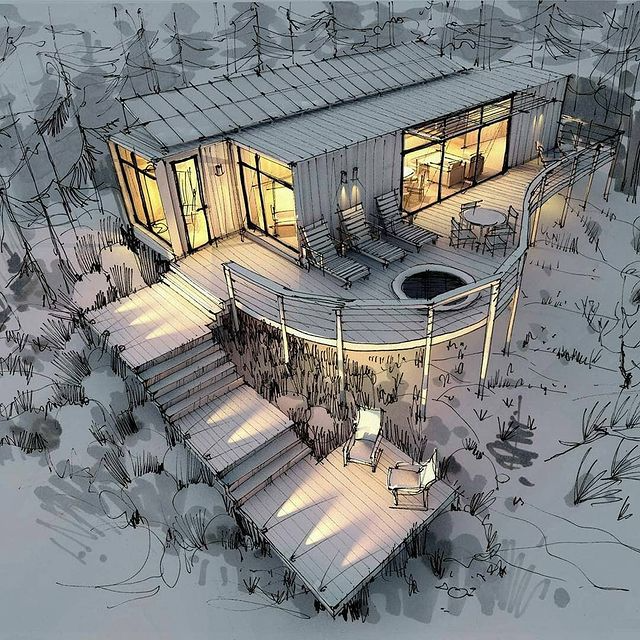
Choose one place each week. Make a short sketch, note three observed activities and identify one conflict. Develop two possible responses and explain the advantages and limits of each. Discuss them with a colleague who can question the assumptions, rather than only judge the appearance.
At the end of a month, compare the exercises. Did the questions become clearer? Did you consider users and construction earlier? For an elevation exercise, relate facade design to openings, sun and the rooms behind it. These repeatable habits help turn inspiration into an accountable architectural process.