
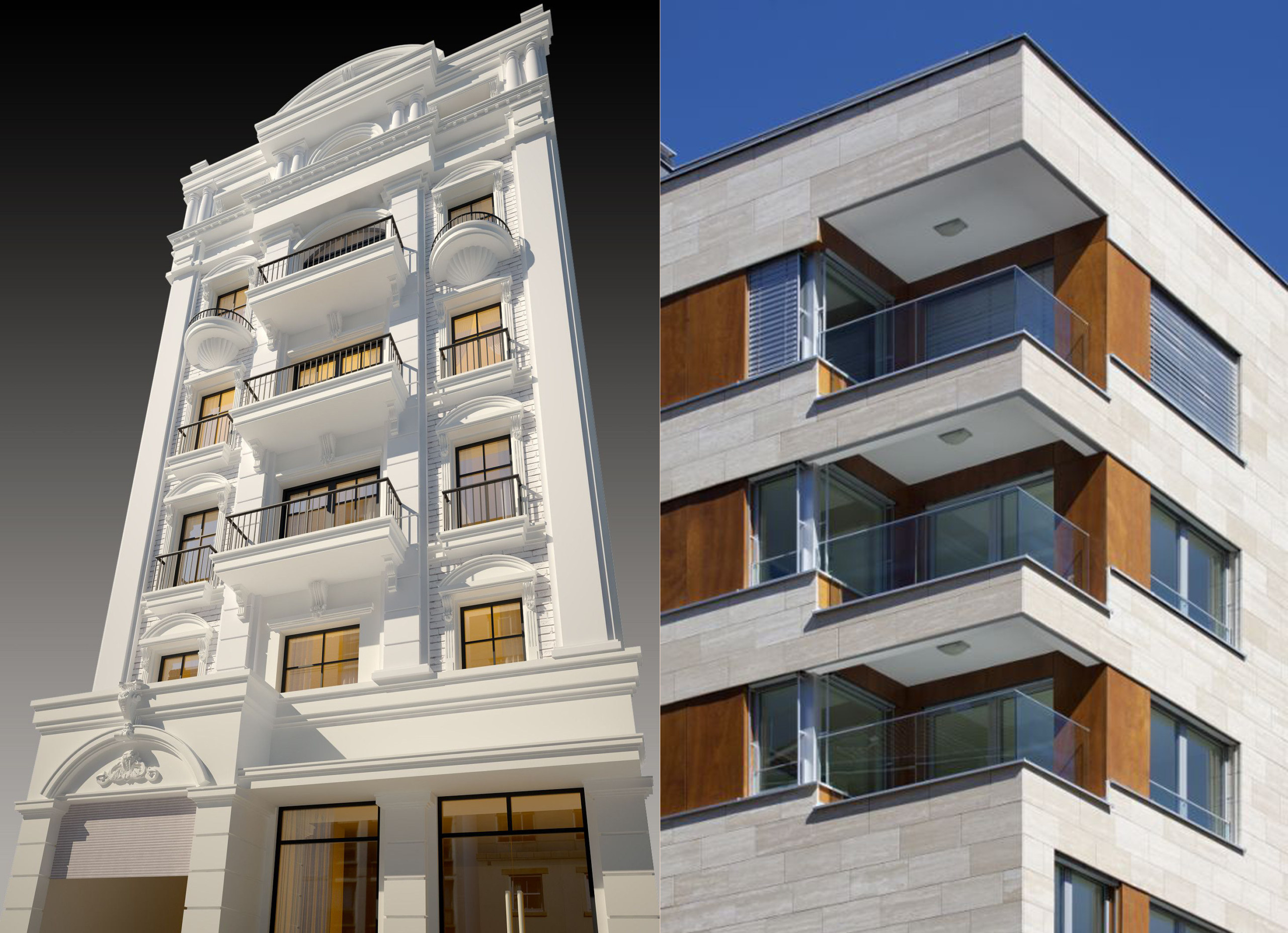
Is a modern or classical facade the better choice? The answer depends on the site, building use, construction budget and client priorities. A style name alone cannot establish quality or guarantee a higher sale price. Farid + Arjmand approaches the comparison through the requirements of the individual building.
Architectural identity and commercial value
A facade contributes to a building’s first impression, but its market reception depends on location, workmanship and buyer preferences. A designer’s identity can emerge through proportion, material decisions and careful detailing rather than an arbitrary signature feature. Compare both options against the same brief before making assumptions about financial returns.
How modern and classical facades differ
Classical compositions often use clear axes, balance, repeated openings, cornices and stone details. Modern compositions allow more freedom in arranging volumes and combining materials. These are tendencies rather than fixed rules: modern architecture can be symmetrical, and a classical treatment can be restrained.

Appearance is only one part of the assessment. Window proportions, entrance hierarchy, material junctions and the relationship between floors also shape the result. Both styles need credible installation details and a realistic approach to cleaning and maintenance.
Local review and the approved design
The original article discusses facade review committees in Iran. The applicable review process depends on the project location and the responsible authority; it should not be presented as a universal requirement. Confirm the relevant requirements before construction and coordinate proposed changes rather than assuming that an initial approval covers every later alteration.
Creativity within classical architecture
Creativity is not exclusive to modern architecture. A classical facade can be developed through proportion, opening rhythm and the careful reduction of unnecessary ornament. “Semi-Roman” is a market term used for some simplified treatments, rather than a consistent historical classification. See the related guide to designing a Roman-style facade for a closer discussion of this vocabulary.
Creativity within modern architecture
A modern approach can explore geometry, shading and material combinations without insisting on strict symmetry. Local architectural traditions can inform its rhythm and response to the site. Modern architecture is an independent movement, not simply a midpoint between classical and postmodern design.

Comparing two proposals for the same building
Assess both proposals using the same spatial brief and budget. Look at openings, privacy, shading, junction details and maintenance access alongside the rendered appearance. Ask for drawings that explain how each option will be built. A facade design process should turn a visual preference into a coordinated construction proposal.
Choose the option that fits its surroundings, supports the client’s needs and has clear, achievable details. The original article also includes a link to Farid + Arjmand on LinkedIn.