
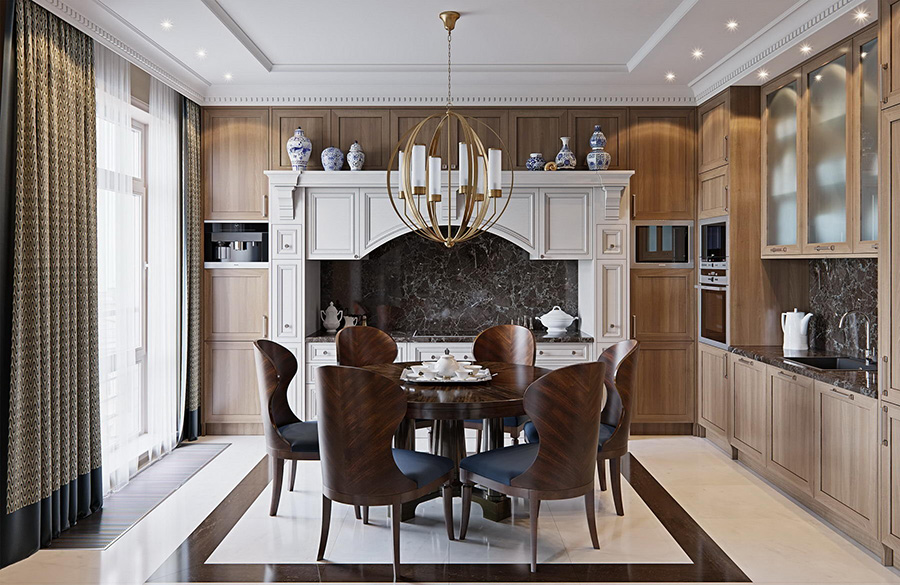
Neoclassical interiors reinterpret classical proportion and elements while accommodating contemporary living. Historically, Neoclassicism developed in the eighteenth century with inspiration from ancient Greece and Rome. Its emergence should not be explained as a mixture with twentieth-century architectural modernism. Today’s decoration market sometimes uses the term more loosely, so clarify what it means for the individual project.
Proportion, symmetry and function
Start with doors, windows and circulation before arranging wall frames and details. Relative symmetry can establish visual order, but should not override usability. Classical approaches to villa facades provide related exterior context without requiring facade ornaments to be copied inside.

Materials and accessories
Wood, stone, metal and glass can work together when the composition remains coherent. Mirrors, lighting and selected objects help articulate the space; expensive finishes and gold accents are not universal requirements. Review these neoclassical interior references as inspiration, then adapt them to room size and budget.
Furniture, rugs and colour
Furniture with a clear frame and restrained ornament can relate to the walls. Fabric selection should address comfort, use and maintenance rather than price alone. Size rugs around furniture groups and movement routes: a large rug is not automatically wrong, and a small one is not obligatory. Neutral foundations may support blue, green or warm accents according to light and user preference.

Kitchens and bedrooms
Coordinate kitchen cabinetry and mouldings with appliances, storage and lighting. White curtains or one prescribed material are not compulsory. Bedrooms need usable layouts, appropriate light and privacy; no single warm flooring colour or cool bed colour suits every occupant.
Scale and lighting before ornament
High ceilings and large windows can help some compositions but are not prerequisites. Smaller spaces may benefit from shallower frames and fewer objects. View finish samples under actual lighting and select furniture at its real dimensions, rather than filling a rendering with accessories.
Historical context and contemporary use
The V&A reference on Robert Adam explains the historical inspiration. Contemporary interior design then relates proportion and materials to circulation and daily needs. This article stays with the neoclassical approach rather than attempting a complete guide to every design movement.