
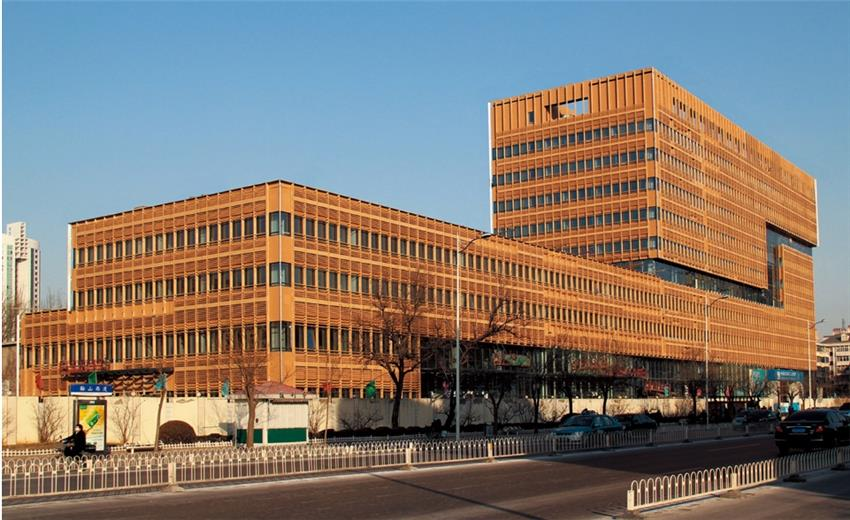
Terracotta is a fired-clay material used in architectural cladding in different shapes, colours and finishes. A terracotta facade is not one standard product: panels, tiles and shaped elements have different fixing and installation requirements. In facade design, the material should be selected together with the wall build-up and its construction details.
Surface, colour and format
Unglazed surfaces retain a fired-clay appearance, while glazed products offer another range of colours and finishes. Panel dimensions, profiles and joints influence the rhythm of the elevation. Review physical samples under relevant light conditions rather than relying only on digital images. Compare shade variation and replacement availability before specifying a large area.

A cladding system, not just a panel
Some terracotta systems use a ventilated cavity and mechanical supports. The supporting frame, fixings, insulation, weather-control layers and cavity barriers must work together. A cavity alone does not guarantee insulation or fire safety. The manufacturer’s installation guidance illustrates why details are specific to the chosen system.

Movement, drainage and junctions
Allow for movement and the tolerances of both panels and supports. Resolve corners, window reveals, parapets and the base of the wall so water can be controlled without compromising the intended pattern. Coordinate panel modules with openings early; late cutting or awkward narrow pieces can weaken the composition and complicate assembly.

Performance and maintenance
Impact resistance, fire classification, moisture behaviour and durability should be checked in product and system documentation. Do not assume every terracotta assembly is suitable for all climates or seismic conditions. Service life depends on the product, fixings, installation and exposure, and should not be reduced to a universal number. Plan inspection access and a practical method of replacing damaged units.
Using terracotta within the architectural idea
Consider how the material supports scale, depth and repetition. The original terracotta cladding reference provides further material context. Our article on four unusual building facades discusses different approaches to identity; here the focus remains the terracotta system and its buildable details.