
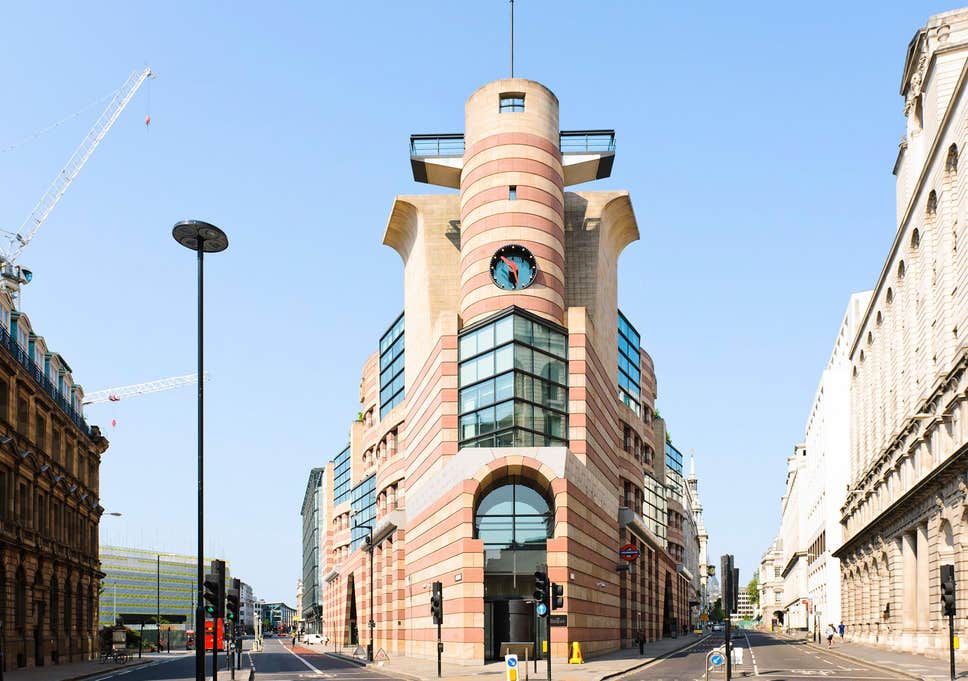
A response to a single architectural language
Postmodern architecture describes diverse approaches that questioned the universal solutions and restrained formal language associated with parts of twentieth-century modernism. It gained prominence in the second half of the century, particularly during the 1970s and 1980s. It is not a label for every building constructed after modern architecture.
Rather than removing history, symbolism or ornament from consideration, postmodern designers used them as potential sources of meaning. A building could acknowledge its location, communicate through familiar forms and invite more than one reading. The Victoria and Albert Museum’s introduction to postmodernism offers useful historical context.


From cultural debate to architectural questions
The broader term postmodernism appears in philosophy, literature, art and cultural criticism. These fields do not share one fixed doctrine, and architectural practice cannot be reduced to a single philosophical slogan. Questions about plurality and interpretation become architectural questions about context, representation and the relationship between form and use.
Comparisons such as Ihab Hassan’s modernism–postmodernism table are interpretive frameworks, not building specifications. References to Dadaism in that discussion concern a wider cultural genealogy. They do not mean a postmodern building must reject structure, practical function or every form of judgement.

Complexity and contradiction
Robert Venturi challenged the idea that architectural clarity requires eliminating every ambiguity. Complexity and Contradiction in Architecture encouraged attention to the layered, sometimes conflicting conditions already present in buildings and cities. Complexity in this sense can be organised rather than arbitrary.
For a designer, the important question is what a contradiction contributes. An entrance that serves the street differently from the interior, or a facade that responds to several neighbouring scales, can create a meaningful relationship. Simply adding unrelated motifs does not establish a convincing architectural argument.


Learning from Las Vegas and architectural communication
Learning from Las Vegas was developed by Robert Venturi, Denise Scott Brown and Steven Izenour. It examined the commercial landscape and the communicative role of signs, symbols and ordinary buildings. Its value extends beyond copying bright signs or entertainment venues.
The discussion distinguishes buildings whose overall form carries a message from relatively ordinary structures whose signs or decorative surfaces communicate identity. This invites designers to examine what a building says to different users and how that message relates to its actual programme.

Historical references and double coding
Charles Jencks helped frame postmodern architecture as a language capable of addressing different audiences. Double coding describes the possibility of a work communicating through more than one architectural register, including recognisable historical references and contemporary design decisions.
Columns, pediments, arches and colour may appear in altered proportions or unexpected combinations. They can be used seriously, playfully or ironically. The result should be understood through the whole composition rather than classified by one isolated decorative detail.

Context, public space and the facade
A postmodern approach can attend to local history, the street and the expectations of people who use the building. Context does not require imitation: a new composition may reinterpret familiar elements while retaining a clear contemporary purpose.
Within facade design, test the hierarchy of openings, entrance, base and roof edge against the building’s scale and surroundings. Piazza d’Italia is one example of how historical language can become part of a public-space composition; it should not be treated as a template for every project.


Distinguish postmodernism from high-tech architecture
The source article also includes images and discussion of high-tech architecture. High-tech work emphasises technology, structural systems and sometimes the visible organisation of services. Sharing a historical period with postmodernism does not make the two identical.
Neither an exposed structure nor a curved glass wall is sufficient evidence of a postmodern design. Read the building’s organisation and historical context before assigning a stylistic label. These neighbouring subjects merit their own detailed articles.

Eco-tech is a separate environmental discussion
Eco-tech connects technological decisions with environmental performance. Shading, ventilation, daylight and the building envelope may be part of that investigation, but environmental ambition cannot be confirmed from appearance alone. Performance depends on design, operation and measurable conditions.
The environmental illustrations reproduced from the original article are retained here as contextual material. They do not establish that every sustainable or technologically advanced building belongs to postmodern architecture.

How to read a postmodern building
Begin with the programme and location. Then examine proportions, references, symbols, material changes and the relationship between the exterior and interior. Ask whether these decisions clarify a coherent position or merely accumulate decoration.
Postmodern architecture remains useful as a discussion of plurality, communication and the reuse of architectural language. Its lessons concern thoughtful relationships between history, place and contemporary needs, rather than an instruction to make every building visually complicated.