
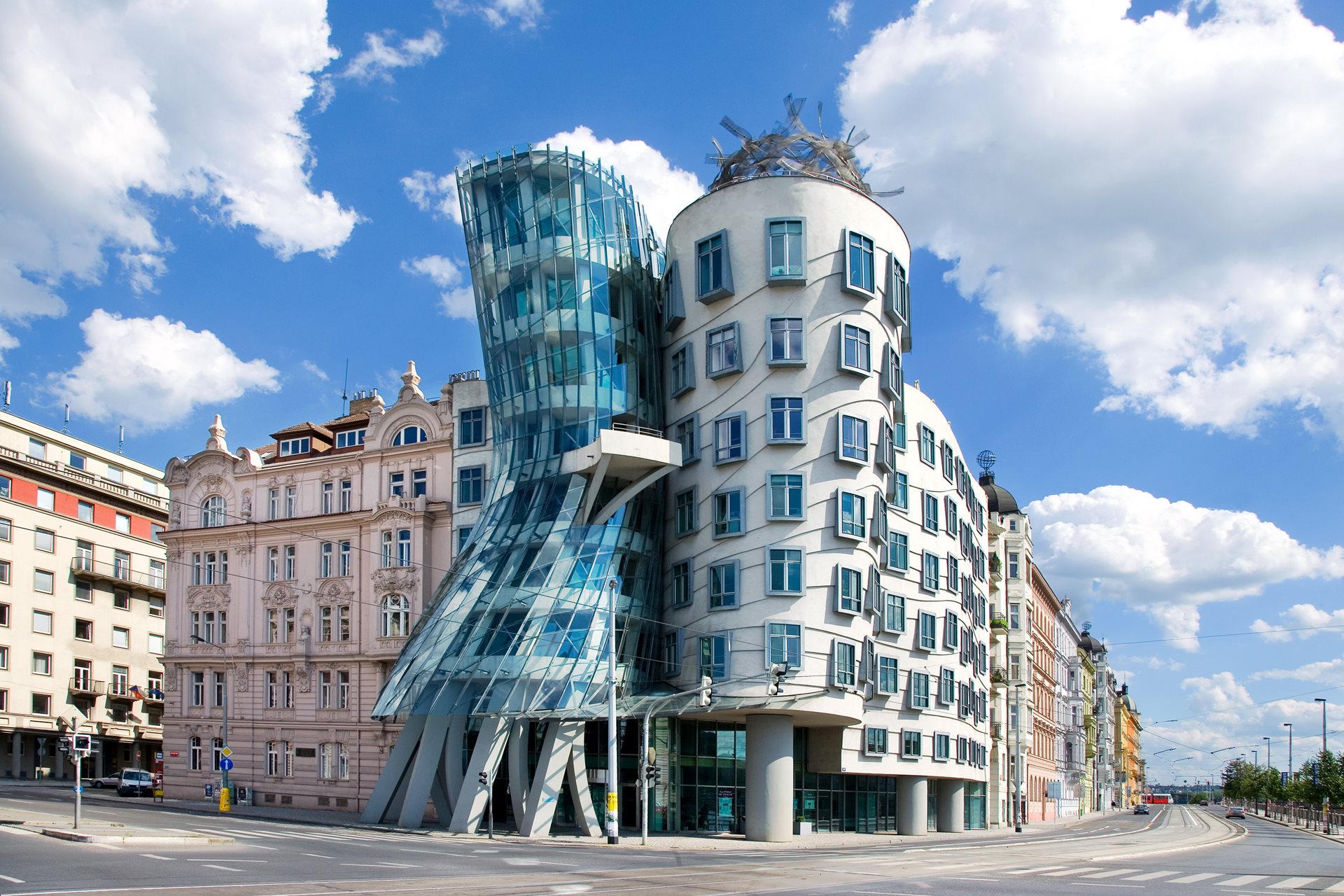
This second study of remarkable buildings by Farid + Arjmand looks beyond unusual appearance. The Dancing House, Machu Picchu and Centre Pompidou offer contrasting lessons about urban context, terrain and the expression of technical systems.

Dancing House: movement within the city
Frank Gehry and Vlado Milunić designed the Dancing House in Prague. Its contrasting volumes suggest movement beside a historic streetscape. The site had previously contained a building destroyed during the Second World War.
The useful design question is how a contemporary composition addresses its neighbours. Contrast need not mean ignoring context: scale, street alignment and the experience at ground level remain important alongside the expressive upper form.

Machu Picchu: building with the mountain
The Inca complex in Peru sits approximately 2,430 metres above sea level. UNESCO’s account of Machu Picchu describes the close relationship between its walls, terraces, routes and mountain setting. Architecture and terrain are read together.
Agricultural terraces should not be confused with circulation stairs. Retaining structures and drainage are important to understanding the site. Some carefully fitted stonework uses no mortar, but calling the stones “earthquake-proof” or claiming every piece returns to position would be misleading. Durability depends on the whole structure and ground conditions.

Centre Pompidou: making systems visible
Renzo Piano and Richard Rogers designed a building with structure and substantial services expressed externally, allowing flexible internal spaces. It is a major example of high-tech architecture rather than the sole starting point of that movement.
The official architecture account explains the building’s visible organisation. Circulation, structure and services become part of the exterior composition rather than an afterthought concealed behind a conventional facade.
Compare decisions rather than spectacle
The three examples use sculptural contrast, adaptation to terrain and technical expression differently. Compare how people enter and move, how the building meets its surroundings and how construction supports the idea. That approach turns a collection of famous images into a useful architectural exercise.