
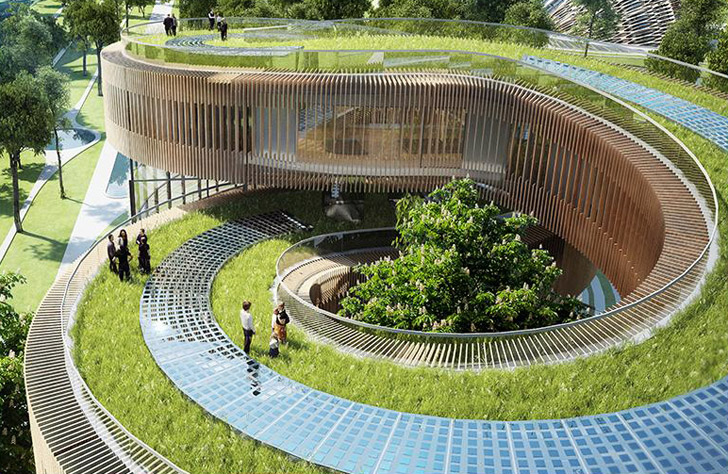
Sustainable architecture aims to reduce a building’s environmental impact throughout its life while supporting health, comfort, economic viability and social responsibility. Plants or a particular facade appearance are not proof of sustainability. The approach requires coordinated decisions and measurable outcomes from design through occupation and renewal.
Sustainability and green architecture
Sustainability overlaps with green architecture in energy, water and materials, while also addressing usability, operating costs and useful life. A building cannot be judged by its appearance or a single feature such as a green roof.

Consider the entire life cycle
Assessment starts with the site and brief, then includes material production and transport, construction, operation, maintenance, renewal, reuse and eventual disassembly. A solution may reduce operational demand while increasing material impacts; comparisons need a defined scope and suitable data. The Whole Building Design guidance connects these decisions to overall building performance.
Climate, energy and the envelope
Orientation, shading, insulation, airtightness and suitable ventilation help reduce demand before efficient equipment is selected. Technology supports climate-responsive design rather than replacing it. In facade design, glazing proportions, shading and thermal bridges must be coordinated with comfort and daylight: more glass does not automatically produce better performance.
Water, materials and maintenance
Water-efficient fixtures and planting suited to the climate can reduce demand when operation and maintenance are considered. Material decisions should include durability, emissions, repair and reuse rather than initial price alone.
Local sourcing may reduce transport, but production methods, service life and the source of raw materials also matter. One imported material does not automatically make an entire building unsustainable; alternatives should be compared within their actual life cycle.

Social value and adaptability
Air quality, daylight, thermal comfort, accessibility and connections to the surrounding community contribute to sustainability. Adaptable spaces may extend a building’s useful life as needs change, provided the structure and services support them.
Attention to context and identity appears in several architectural traditions. Examples of postmodern architecture offer a cultural comparison, but membership of a style does not establish environmental performance or make that style inherently the most sustainable.
How to evaluate the outcome
Set clear measures for energy, water, comfort, costs and maintenance, then compare predicted performance with observations during use. Sustainability claims need evidence and follow-up rather than a list of materials or technologies.
Start with the priorities of the site and users and select feasible solutions within the budget. Early coordination between architecture, structure and services helps turn ambitions into buildable details and reduces conflicting decisions.