
Postmodern architecture uses historical reference, symbolism, colour and multiple readings to reconsider some conventions of modernism. An unusual shape alone does not establish the category: a building must be read through its history, purpose and setting. The following examples distinguish clear references from useful comparison cases.
How to read the examples
Our articles on postmodern architecture and the meaning of postmodern architecture introduce the movement. This article concentrates on buildings rather than treating every contemporary landmark as postmodern.

The Portland Building: colour and civic symbolism
Michael Graves designed the Portland Building, completed in 1982. Its regular mass is combined with contrasting colours, enlarged motifs and historical references reworked rather than copied literally. The Michael Graves project record documents its place in the practice’s work.
Vanna Venturi House: familiar elements reconsidered
Robert Venturi designed this Philadelphia house for his mother. The pitched roof, chimney and entrance recall a familiar image of home, while their relationships complicate straightforward symmetry and expectation. Its significance lies in the composition of meaning and space as well as its appearance.
M2 in Tokyo
Kengo Kuma’s M2 combines classical references with unexpected scales and relationships. Oversized elements create a deliberately dense visual composition rather than a conventional classical frontage. Kengo Kuma’s official M2 project page provides a direct source for the building.
The Thompson Center and Swan and Dolphin hotels
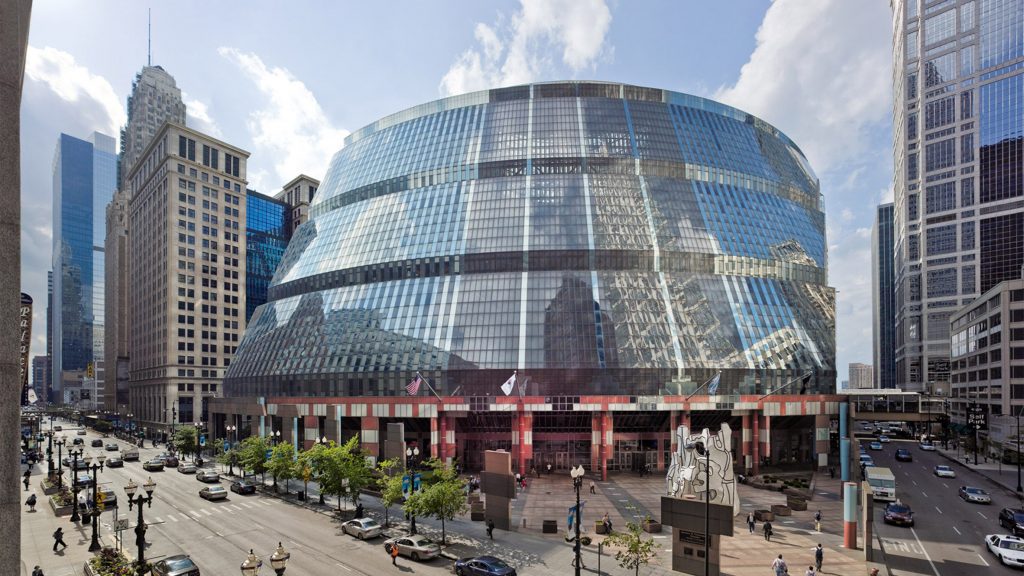
Helmut Jahn’s Thompson Center in Chicago combines a glass enclosure with a large central interior. It provides a useful comparison between technical expression, public space and symbolic presence, although architectural classifications of the project vary.
Michael Graves designed the Swan and Dolphin hotels at Walt Disney World in Florida. Their forms, colours and animal symbols respond to an entertainment setting. This does not make every Disney building an example of the same movement.

Guggenheim Bilbao: a comparison case
Frank Gehry’s Guggenheim Museum in Bilbao is an important contemporary landmark with curved volumes and titanium cladding. It should not be presented as an unequivocal postmodern example: it is also discussed through deconstructivism and sculptural design. The museum’s construction account identifies the site as a former industrial wharf; describing it simply as a rubbish dump is misleading.
What designers can learn
Useful comparisons address scale, the street experience and interior organisation instead of reproducing visual symbols. Postmodern facade design develops the stylistic topic separately. Practical facade design also requires material selection, connections, maintenance and climate response, whatever the architectural language.