
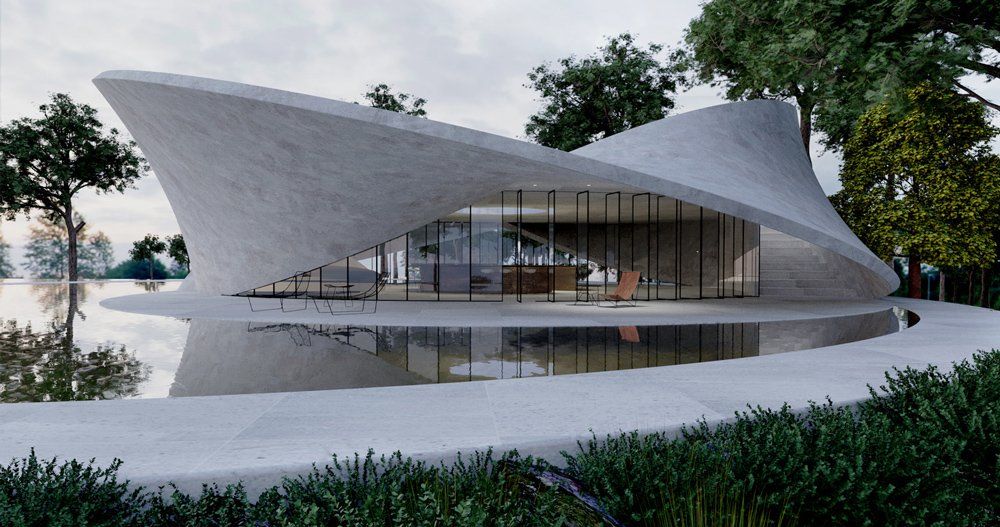
Arches and curves can shape structure, movement and the character of a space. Their role ranges from carrying loads to framing an opening or softening a junction. Understanding what a curved element actually does is more useful than assuming that every arch is structural or every curve improves a room.

Structure and architectural expression
A structural arch transfers forces through its geometry toward its supports. Its capacity depends on the span, rise, material, section, loading and support conditions. A curved profile alone does not guarantee greater strength than another system.
Contemporary arches may be built from different structural systems or used as non-structural finishes. The visible shape and the load-bearing element are not necessarily the same. Identify the real construction before making claims about performance or choosing a decorative reference.
Curves in the interior
Curved walls, ceilings and joinery can guide movement or distinguish a place within an open room. Curved-wall references offer visual examples, but each should be evaluated against furniture, access and useful dimensions. A smooth line on a plan can still leave an awkward space behind it.
In interior design, consider the curve at doorways, floor edges and furniture junctions. It may make a transition feel gentler or more continuous, but emotional responses vary with scale, lighting and use. It is not accurate to promise that curves always calm everyone or that angular rooms are inherently uncomfortable.

Curves on the facade
Arched openings and curved volumes can contribute to the rhythm and identity of facade design. Their relationship with windows, shading, waterproofing and the rooms behind them needs attention. An arch added to an unrelated opening may complicate construction without improving the composition.
Material and facade colour change how the curve is perceived. A heavy stone surround and a thin metal edge express different qualities even when their outlines are similar. Review the whole elevation rather than judging a single attractive detail.
A curved landmark as a study
The Gateway Arch illustrates how a clear curved geometry can define a landmark. Its official architectural account describes Eero Saarinen’s design as an inverted catenary. This example is useful for studying the relationship between form and construction, not as a generic solution for an ordinary doorway.
From concept to a workable detail
Document the geometry and the junctions with floors, walls and openings. Check how the material will be formed, divided and fixed, and how joints and tolerances will appear. Curves may require additional coordination at corners and transitions; their cost and difficulty depend on the proposed system.
Before retaining a curve, explain its purpose. Does it organise movement, support a load, frame a view or establish a deliberate rhythm? If the answer is only that it resembles a reference image, compare a simpler alternative. An intentional curve should contribute to the architecture as well as its image.