
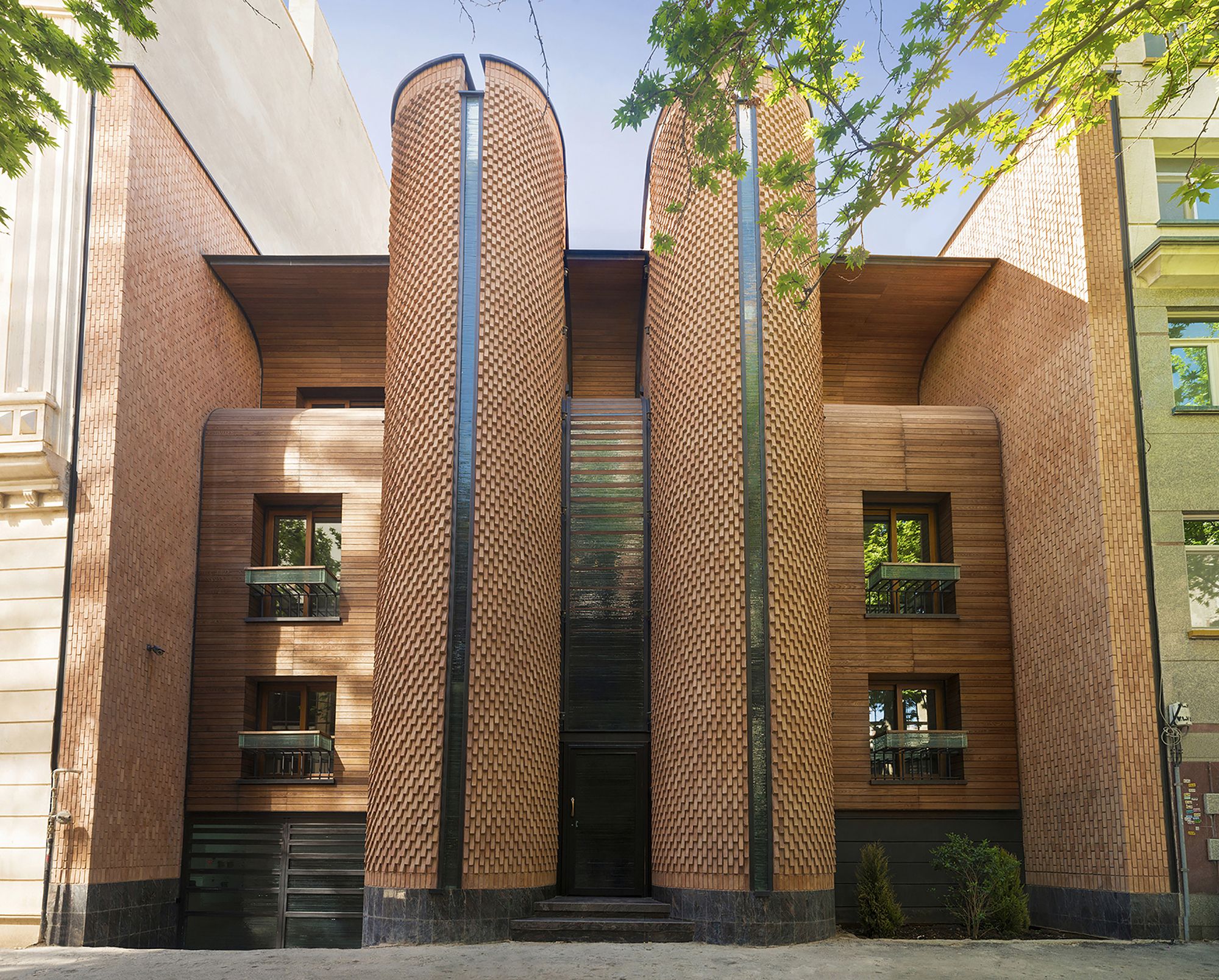
Brick has a long presence in Iranian architecture. It can support a contemporary elevation or recall local building traditions, but the material alone does not determine a style. Proportions, openings, bond patterns and the relationship to the street shape the result.
In facade design, appearance and performance need to work together. An elevation is part of the building envelope, with requirements for moisture control, thermal performance, support and long-term maintenance.

Traditional material, contemporary composition
Different unit sizes, colours and textures allow a variety of rhythms and depths. Projecting or rotating units can cast changing shadows, but expressive arrangements still require reliable support and workable construction details. A three-dimensional model does not resolve those details by itself.
Our overview of architectural approaches explains why a style involves more than a material choice. The architectural project archive also shows materials used in different contexts.

Durability, insulation and environmental impact
Quality brick can provide a durable surface. The life of a facade also depends on mortar, connections, workmanship and detailing. Water absorption and freeze–thaw resistance must suit the exposure conditions.
Brick’s thermal mass can influence wall performance, but facing brick does not replace insulation. Assess the full wall assembly, glazing and thermal bridges. Firing brick also uses energy; environmental performance depends on production, transport, service life and opportunities for reuse.

Shade and privacy
Open brick screens can reduce some views into a balcony while allowing light and air to pass. Their effectiveness depends on viewing angles, gap sizes and the distance between the screen and the occupied space.
Brick elements around an outdoor walkway can provide partial shade. Every arrangement nevertheless needs structural assessment and properly designed connections. A visually light screen still has weight and is exposed to wind loads.
Moisture and fixing details
Resolve drainage, drip edges and junctions with windows and other materials. Efflorescence is commonly associated with moisture carrying salts; cleaning the surface without addressing the cause may not prevent recurrence.
Wet or windy climates do not automatically rule out brick. Suitability depends on the product, support system and site-specific details. Loads and connections need review by the relevant professionals before construction.
Samples, cost and maintenance
Review a sample panel that includes a corner, opening and joint in the actual light of the site. A small unit may look different from a full elevation. Compare supply, transport, waste, installation and maintenance rather than unit price alone.
Execution services connect the drawings to these site decisions. Samples and inspection during installation help maintain the design intent and reduce unplanned changes.